Showing posts with label journalism. Show all posts

Friday, 27 February 2009

Misc thoughts: Silverlight, Flash and Twitter

I've been on a Flash for Beginners course for the last two days. My hope was that learning the basics that way and spending some time with Mindy McAdams book Flash Journalism would result in some skills and ideas for interactive multi-media storytelling I could spread around our business. We shall see. I think the main lesson so far is that Flash is very complicated and it would take huge commitment on the part of a journalist to master it.

Anyway, early days. I was quite pleased with the animated bug I made on the course but I don't think it will be winning a Pulitzer Prize.


Meanwhile Journalism.co.uk alerted me to something I had missed in the whole Obama overload thing - it's a CNN.com multimedia Silverlight thing which stitches lots of photographs together and lets you freely navigate through them (if you have the will). But the one that caught my eye was the UGC set which is basically composed of photographs from people around the world which show them watching the Obama inauguration on television. I found myself moving from scepticism to compulsion quite quickly. Nice use of UGC.

Finally, Twitter. It's gone mad of course. It's great that so many of our editorial people have suddly taken the plunge and hopefully the n00bs1 will start talking to people in their markets rather than just to each other any day now. Meantime, I'm finding Twitter rather overwhelming. It feels like ambient noise rather than ambient intimacy. I may switch it off.

Footnotes

1. For definition of n00b consult 140pedia which is dedicated to providing definitions no longer than 140 characters for the Twitterati.

Saturday, 8 November 2008

A masterclass in Internet forensics

Utterly absorbing account of how one man's curiosity about mysterious lawn signs advertising dating services led him to appreciate the brilliance of a $45 Million Internet business.

Essential reading for journalists who need to know how to prise information about the Internet out of the Internet.

Friday, 19 September 2008

Passion Points

Oops. I coined a new piece of jargon yesterday. Didn't mean to. It just slipped out.

I was looking for a way of describing both the people who are excited and the things that are exciting in our markets.

And out it came: Passion Points.

Let's look at the second instance: things. The Passion Points are the things that excite our audience. This isn't generally the day to day stuff of their business lives (our sites are all b2b remember) - it's the stuff that generates real passion and excitement.

In agriculture we refer to it as "tractor p*rn"; in road transport, it's big lorries. Boys and their toys, I suppose.

When encouraging user contribution or engagement, these passion points are the way to go - best return for least effort.

Of course in some cases, people are passionate about their jobs - it's a vocation. Our CareSpace community for social workers has taken off really well because these people are passionate about what they do (I'm reasonably sure they don't do it for the money).

The other application of Passion Points is people. Who are the journalists in our organisation that are really passionate about what they're covering? This is important because the biggest "threat" to our business as publishers comes largely from bloggers who are often passionate non-professionals. It's their passion that's makes them exciting and makes it difficult for "career journalists" (those who are journalists by trade and move from market to market writing about different things) to compete with them.

Luckily we have many impassioned and dedicated journalists working for us but I confess that when I was an editor here some years ago I would have failed the passion test; in those days we were only competing with other trade magazines.

But what about the people we employ who - although diligent and skilled - are not passionate? How do we help them compete?

I'm reminded of the late Bob Monkhouse's observation about success in showbusiness: "The secret of success is sincerity. Fake that, and you've got it made."

If only it were true.

Friday, 18 April 2008

Editors are more neurotic than readers

"58 percent of editors said letting journalists join online conversations and give personal views would harm journalism, but only 36 percent of the public agreed."

Nice to have some research back up this counter-intuitive claim that we've always assumed here. Of course, it's not quite as satisfying as saying that 64% of the public thinking that it enhanced journalism, but you can't have everything.

This research is from an Online Journalism Credibility Study.

Other interesting findings:

Some 70 percent of editors surveyed said requiring commenters to disclose their identities would support good journalism, while only 45 percent of the public did.
...

Expressions of personal views seem to help boost readers' interest and trust in Web sites, said John `Bart" Bartosek, editor of The Palm Beach Post in West Palm Beach, Fla., and chairman of the credibility committee for the AP managing editors group.

"That's contrary to most of the traditions we've all grown up with, to keep our opinions, viewpoints and personal lives out of our story," Bartosek said.
Somewhere in there is something about readers feeling more trust when they feel they know the person behind the journalist (c.f. blogging).

Friday, 4 April 2008

The role of the features editor in a digital world

When we talk about the digital journalist it is most often in the context of news reporting (because statistically most of our staff journalists are news people.

But in the back of my mind I often wonder where to begin in describing the role of the features editor in an online context.

Well, here is a good place to start. It's a Reuters online "feature" called "Bearing Witness" to mark five years of the war in Iraq.

It features a timeline, maps, photography and so on and while it's not unflawed (does the whole thing have to be in Flash? How irritating!) it's an excellent illustration of what a good online feature looks like (i.e. not 1,500 words with a few links thrown in).

Tuesday, 11 March 2008

Journlaism: back to basics (not a deliberate mis-spelling but it seems appropriate to leave it)

I've suggested before that those of us who deliberately entered journalism probably imagined ourselves to be a potential Bob Woodward or Hildy Johnson (right).

Alas, I have never worn a hat like Rosalind Russell's but it has been fun nonetheless.

And it's really exciting being in the midst of so much change (although that is easy for me to say as I'm no longer a journalist).

Anyway, all of which is a long winded intro to a fabulous video uncovered by DigiDave who offers some analysis.

I, however, offer merely entertainment and nostalgia for a time even I don't remember (except to say: note the emphasis on words; a tyranny that lives on).

Thursday, 3 January 2008

A video journalism primer

My overseas colleague Mr Blank has culled together some interesting links to stuff about video... And you can find it here..

Friday, 21 December 2007

A community tale to warm the cockles of your heart


As it's Christmas.

Farmers Weekly has had a thriving online forum for many years.

This year they upgraded their software to provide a faster, more fully featured service (including photo-sharing and community blogs) using the Community Server platform.

The result is a thriving and growing community (the 1,000th new member signed up this week) which has strengthened in the most unexpected ways.

The photograph above shows two of the most active members - kansasfarmer and AllyR and their respective spouses (Mrs kansasfarmer and Mrs AllyR, of course).

In a dramatic transition from online to "IRL", kansasfarmer and Mrs KF visited the UK this year and stayed with various members of the online community (the dollar being what it is, this was probably the only way they could manage it!).

Other highlights included one of the members blogging very personally about the process of adopting a child in China. Meanwhile another farmer blogs from Transylvania. You couldn't make it up.

Farmers are - by the nature of their jobs - quite isolated and the fact that they develop such strong relationships and take the trouble to blog about their lives to the rest of the community is really heart warming.

Moreover - from our point of view - it has quite dramatically changed the way that news decisions are made. Journalists are able to see what the hot topics are as they emerge on the forums and get feedback, information and try out ideas.

This is a fundamental shift in journalists' attitudes and - indeed - to the way that we go about communicating.

When the dreaded Foot and Mouth Disease reared its ugly head again this year, the forums proved the fastest, most effective way of getting bullets of news out to the community (especially overnight).

Moreover, it gave the community a way of feeding back what exactly they wanted the journalists to research - everything from "Can I move my cows from here to here?" to "If this outbreak has come from a government lab, can we sue the government?".

It's brought the Farmers Weekly brand, magazine, website and journalists much closer to the people they are serving.

And - dare I say it - puts the farmers very much in the editorial driving seat. Fantastic.

Gets you right there, doesn't it?

Bloggers entitled to protect their sources

Thanks to colleague Andrew Doyle for spotting that a US court has ruled that bloggers are as entitled as journalists to protect their sources.

The BBC reports that computer firm Apple brought a lawsuit to make fan site Think Secret reveal who had leaked details about the cut-down computer.

Apple is notoriously secretive about forthcoming products and it sued Think Secret claiming that bloggers should not enjoy the same rights to protect sources granted to mainstream journalists.

A California court initially sided with Apple but the hi-tech firm lost the case on appeal. The outcome of that said bloggers should be considered as journalists and subject to the same protections.

The Electronic Frontier Foundation (EFF) aided Think Secret in its legal fight to stop Apple forcing it to reveal its sources.


But it reports that the end result of the case is that Think Secret will be closed down.

Think Secret issued this press release:

Apple and Think Secret have settled their lawsuit, reaching an agreement that results in a positive solution for both sides. As part of the confidential settlement, no sources were revealed and Think Secret will no longer be published. Nick Ciarelli, Think Secret's publisher, said "I'm pleased to have reached this amicable settlement, and will now be able to move forward with my college studies and broader journalistic pursuits."


which is presumably the blogging equivalent of "spending more time with his family" in UK politics.

But a good judgement, nonetheless.

Monday, 10 December 2007

How journalists can use social networks to improve beat reporting

If you haven't already seen it, do check out BeatBlogging.org, an experiment to explore combining beat journalism with social networks.

The aim of the project is explained thus:

Are there network effects in beat reporting? Across the US, a dozen reporters (with beats) are going to try to find out—simultaneously. This will improve their odds of succeeding.

This is a simple project testing a single idea: Maybe a beat reporter could do a way better job if there was a “live” social network connected to the beat, made up of people who know the territory the beat covers, and want the reporting on that beat to be better.

That’s the entire idea—so far. Beat reporting with a social network: can we get it to work?. And here is the rest of it.


Check it out on Beatblogging.org where the journalists are blogging as they go. Fascinating stuff.

Friday, 14 September 2007

Old quotes never die

One of the most beguiling aspects of the Internet is that while it feels for those of us who create content (as journalists or users) as though the content is transient - one minute a story is on a home page, the next it's languishing deep in the long tail - that's illusory. I was interested to read this article in Online Journalism Review by Elizabeth Zwerling, an associate professor of journalism at the University of La Verne in Los Angeles County:

By the time I got the e-mail from the spokeswomen for a major credit card company asking me to delete her quotes from an article we'd run almost a year before, I was skeptical. She had already contacted the reporter with various versions of her concern: she'd been speaking off the record, the reporter must have confused her with another source, the quotes were wrong. A man "representing" her had called the managing editor urging him to omit the quotes from the archive. "I think he was a lawyer," the managing editor told me at the time. (He wasn't.)

I'm faculty adviser for the Campus Times, a 2,000-circulation weekly newspaper of the University of La Verne in Los Angeles County. My staff of undergraduates occasionally gets things wrong and corrects them. But this was a solid story by a conscientious reporter, puzzled by the content, urgency and timing of the source request.

Most likely the credit card spokeswoman – a woman a Google search revealed is widely quoted by Reuters and CNN, among others – had searched herself online and found our story about college students and credit card debt, in which she spoke openly, if off-message, about the age group's unchecked spending habits.

That's quite an easy one to settle one's conscience. But how about this one:

Editors at the Pasadena (Calif.) Weekly felt they found a fair solution when in 2006, they decided to remove the name of an ex-con from an archived story, six months after it came out in print.

Joe Piasecki, the paper's deputy editor who also reported the story, had covered a protest at San Quentin Prison a week before the execution of Crips co-founder Stanley Tookie Williams, where he interviewed a man who said he'd been in prison with Williams. Piasecki researched the man's background through the Oakland Tribune's (offline) coverage of the man's 1998 trial and found the man had been charged with raping and sodomizing his former girlfriend, and convicted of assault. Piasecki included that information in the story along with the man's claim that he was innocent. "I'd called the Tribune library (to make sure) he was who he said he was," Piasecki said.

The story ran Dec. 8, 2005, in the Weekly, its sister paper the Ventura County Reporter, and on the Reporter's Web site. At the time the story went up, the Pasadena Weekly didn't have a functioning Web archive, so the source's call went to the Ventura, Calif., newsroom first. Then Piasecki and Pasadena Weekly Editor Kevin Uhrich were consulted.

"Our first reaction was 'no don't change it'," Piasecki said. "I tend to say that unless (the reporter) screwed up, don't change it. What's true is true."

Piasecki said his publication made an exception here because the man wasn't familiar with the Internet, and because his quotes toward the end of a story about someone else, were not critical to its "material essence." The man had served two years at San Quentin and remembered seeing Williams there; his quotes added color to the story, Piasecki said. The quotes are still in the Ventura newspaper's online archive, only the man's name was removed.

"The guy said every time he applied for a job they Googled his name and this was the only hit," Piasecki said. "We took his name out so he could move on with his life." (my emphasis)

I've had this issue myself only once and it wasn't nearly as dramatic. A news website I ran carried a run-of-the-mill Employment Tribunal story which involved a (from memory) small nursing home in the Midlands.

Perhaps a year later they called me and begged me to take the story down. They were trying to recruit new staff but when potential applicants did a search for the home on Google, our bottom-of-page-27 article on a minor point of employment law came up first in Google's search results.

Sometimes the Internet, like life, just isn't fair. I shan't tell you what I decided; I hope it's obvious.

Tuesday, 11 September 2007

Should journalism students be taught HMTL?

Many thanks to my colleague Kieran Daly for spotting this version of the chestnut "Should journalists be taught HTML?". This time, the question is posed by the appealingly alliterative Mindy McAdams.

For us, the question is mostly an "old dog new tricks" issues, but Mindy is speaking from a pedagogue's perspective (Damn. Can't stop myself alliterating now Mindy, you Minx)

Anyhoo, I think the answer is almost certainly "yes and no" but my bigger, stroppier questions are "What the hell are they teaching kids in school these days?" and "What kind of skills and attributes should a prospective journalist student have?"

Stroppy Question 1. What the hell are they teaching kids in school these days?

I have no idea, but based purely on casual observation, it sure as hell isn't touch-typing (or, "keyboard skills" as it's probably called these days) which I find amazing. So many people work on a computer (and those that don't probably use one at home) that it's amazing that touch typing isn't a mandatory subject in school in the interests of productivity and health and safety (RSI and all that).

As for learning HTML, well, given that they use computers in schools, you wouldn't think it would take much curiosity to pick up something about HTML along the way.

Stroppy Question 2. What kind of skills and attributes should a prospective journalist student have?

Well in addition to the traditional list...

  1. Touch typing (see SQ1 above)
  2. Blogging (if they don't already have a blog, how serious are they about journalism? And what does it say about their ability to just get on and do stuff)
  3. If they are doing 2, how much have they picked up about HTML and CSS along the way? If they're using Wordpress or Blogger they probably haven't needed to learn much to make it do what they want, but they will if they have any...
  4. ...Curiosity

Friday, 31 August 2007

Is the new journalism not glamorous enough?

Interesting article on ChicagoMag.com revealing extraordinary resistance to change among journalism students.

Last year, after taking over as the head of Northwestern University's highly regarded Medill School of Journalism, John Lavine vowed to "blow up" the curriculum, changing its emphasis to new media and marketing. Students and alumns have responded with anger and charges of betrayal.
Seems that the young are just as resistant to change as anyone else and have illusions of the journalism of yesteryear:
“You lied to me!” the graduate student angrily told John Lavine, the dean of the Medill School of Journalism. “I came here to learn to be a writer,” the student said, explaining that he had chosen Northwestern—and forked over more than $40,000 in annual tuition—because he wanted to hone a flair for writing that would land him at a publication like The New York Times. “But you’re having us do all this video stuff. I didn’t come here for that.”
to which Lavine responds: “It would be unethical for us to educate you to only be able to write,” he said. “It would be like sending you out with your left arm and your right leg tied behind your back.”

Interesting stuff. But really, weren't we all originally inspired to be journalists by Cary Grant and Rosalind Russell?


Tuesday, 21 August 2007

Pity the poor journalist

Interesting blog post by Joel Achenbach at The Washington Post called "I Really Need You to Read This Article, Okay?".


The idea that the ability to measure the popularity of online news stories is as much a curse as a blessing is not new, but this is as very well expressed a summary as one could wish for really. Charmingly written, too.

Monday, 20 August 2007

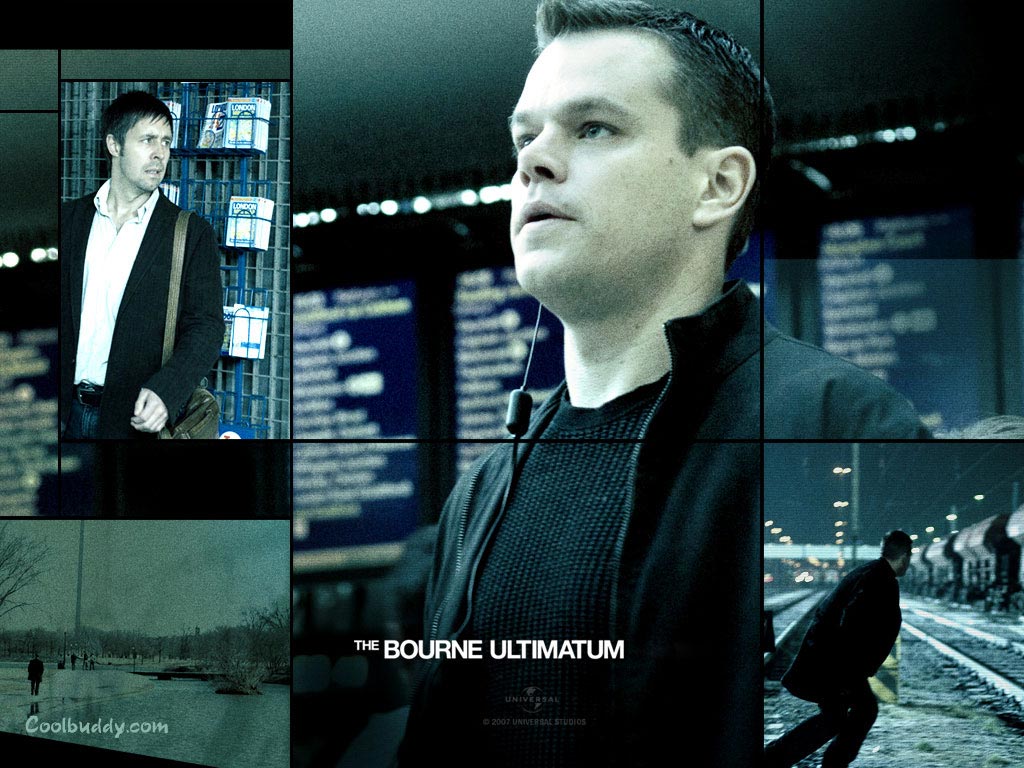
The Bourne Supremacy - behind the journalistic times

The Guardian's review of The Bourne Ultimatum is understandably rather dominated by excitement at the fact that the film features a Guardian journalist.


In an exciting (especially for us sad Londoners) action sequence set in Waterloo Station, hero Jason Bourne is trying to prevent the hapless journalist from being assassinated by the CIA.

I'm sure my blogging colleague Mr Tinworth will be chuckling at reviewer Peter Bradshaw's criticism of the scene:

But there are inaccuracies. The Guardian stylebook clearly states that if you are under a hail of bullets in a public place from an assassin run by a deniable intelligence unit, you have to duck into the nearest internet cafe and start blogging about it to keep the readers informed.
Regardless of that, it's a movie that's worth seeing.