Wednesday, 27 August 2008

Linked In: At last! something to do!

I've managed a group on LinkedIn for ages but - like much else there - haven't managed to find a way to let the members do anything other than join it.

But it seems that this will change:

This Friday, we will be adding several much-requested features to your group:

  • Discussion forums: Simple discussion spaces for you and your members. (You can turn discussions off in your management control panel if you like.)
  • Enhanced roster: Searchable list of group members.
  • Digest emails: Daily or weekly digests of new discussion topics which your members may choose to receive. (We will be turning digests on for all current group members soon, and prompting them to set to their own preference.)
  • Group home page: A private space for your members on LinkedIn.
About time!

Wednesday, 13 August 2008

Hoisting comments

I'm always on the lookout for ways of rewarding users by recognising their content in some way. Our community sites make a point of highlighting the most interesting photos, blog posts, forums etc.

Turns out we are missing a trick by not doing the same thing with comments and apparently it's called "hoisting comments". Like it.

Flicking through the back-story

The Online Journalism Blog draws my attention to a very cute new tool on CNN which lets users browse back through previous items relating to a news story.

For an example, take a look at this Anthrax story on CNN.

Monday, 11 August 2008

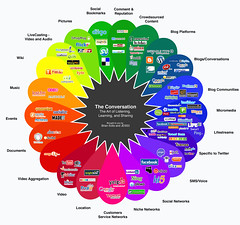
The Conversation Prism


The Conversation Prism
Originally uploaded by b_d_solis
A pretty and useful diagram of social media. Great for generating ideas for tools you can use.

Thursday, 7 August 2008

Monday, 4 August 2008

The Periodic Table of Videos

I LOVE this.

The University of Nottingham (no, stick with me) has created a video on each of the elements in the Periodic Table (I suppose technically that's poor English as there aren't any out of it).

Anyhoo. I love it because:

  • It's fun
  • It's addictive
  • It's interesting
  • It has a natural scope (all of the elements)
  • It is not news - it is information and hence will not age so rapidly.
  • It has its own site and its own YouTube channel to maximise exposure
  • The YouTube channel uses playlists in an intelligent way (e.g. Group XIII Elements)
If all of our markets could come up with a similarly "encyclopaedic" idea we would be laughing.

In the meantime: Here is the most watched video: Sodium.


The 10 Commandments of the Social Web

Essential reading from Nick O'Neill over at Social Times.


Friday, 1 August 2008

Comments on articles - desirable bar the undesirables

As Adam reports, we had an interesting exchange yesterday about journalists' discomfort with comments on articles.

Part of this discomfort is almost certainly a reaction to the unfamiliarity of being so exposed to criticism and/or feedback. I am reminded of Guardian theatre critic Michael Billington's first foray into blogging. Because he's Michael Billington and because they could, people laid into him and one can imagine the poor man's confidence being justifiably shaken by the whole thing.

As Adam points out, the problem for national newspapers' online audience is that they are not and can never be communities.

I hope that Jerry Holkins and Mike Krahulik won't mind me borrowing their famous and beautiful explanation (right) for bad behaviour.

Anyway, I hope that for most of the journalists the shock will pass and they will harden up. I vividly remember the first angry comment I received on a blog of mine and how shaken I was. But what doesn't kill you only makes you stronger (although it sometimes crushes you actually).

Anyway, the point of this post (at last!) is to reflect on what can be done - not only for the sake of the poor journalists but also for the visitor and the brand.

Et voila! Powazek offers 10 Ways Newspapers Can Improve Comments

  1. Require Accounts
  2. Set and Enforce Rules
  3. Employ a Community Manager
  4. Sculpt the Input
  5. Empower the Community to Help
  6. Link Stories to Comments
  7. Enable Private Communication
  8. Participate …
  9. … But Don’t Feed the Trolls
  10. Give Up Control
Now, I don't quite agree quite with all of these because I don't think newspaper websites are or can be communities.

But the comments underneath the post give some fantastic additional insights which I utterly agree with. For example
  • Do not give any truck to users who are unable to distinguish between "freedom of speech" and the freedom to be an offensive arsehole on someone else's website (I'm paraphrasing with that one)
And these recommendations from Robin Hamman:
  • a clearly defined purpose for hosting the discussion
  • a clearly defined set of rules - and staff or super-users empowered to use them
I think these are key. I really don't think publishers need to do so much hand-wringing about democratising comment. It's not a community; it's a website; it's their website. It may be interactive, it may be a "social medium" by virtue of the interactivity, but it's not a community.

It's your website. Set firm but fair rules about conduct and deal with transgressors of the rules firmly and fairly.

Wednesday, 16 July 2008

Is the value of content going up or down or both?

Andy Dickinson's post Time to get your head round fair use is more than fairly useful. Read it. It summarises the English (and Welsh? or UK?) law.

And it has also set me off on something of a tangent.

While the laws relating to copyright and fair use have not changed substantially, "custom and practice" undoubtedly have.

Thanks to Creative Commons I could illustrate a story about protests over Wrexham's proposed incinerator without getting up from my desk, let alone paying any money over to a photographer. All I need to say is acknowledge "CC BY SA http://flickr.com/photos/vertigogen/58184067/"

In the blogosphere it is pretty much acceptable to quote the majority of another person's post providing you "pay" for it with Googlejuice (a link).

Most of our websites make their video embeddable which is implicitly an invitation to use it for free (in return for Googlejuice, natch) although I had an interesting conversation the other day with Debbie from "reprints & eprints". The roots of this department lies in our print history. Advertisers delighted to be written about in an article often purchase reprints which they send out to their clients. We charged for the privelege, of course.

Anyway, Debbie had a client which was featured in one of our videos and they wanted to put it on their own website. How much should she charge them?

My first instinct was to say "nothing" and then I wondered why that was? When did I stop thinking of content as having value? Has the value of content actually diminished? If so, how come? Perhaps I've been brain-washed by the social media free-for-all and have lost sight of it?

Of course, in some cases the value (or, anyway, the cost) of content has actually plummeted. Photography is the main loser here due to flickr, morguefile (from which the picture on the left is taken) and a thousand other sources.

Indeed, our purchasing department has just struck some incredible deals with image libraries and it's not surprising that Getty is trying to claw something back from the free image explosion.

Yet bizarrely many of the photographers we commission persist in clinging on to the copyright of what they produce for us. Freelance writers long ago recognised that the world was changing and that it was in their best interests to give us all rights to commissioned work, much to the NUJ's chagrin. But really: who would you rather buy a frying pan from? Someone who would only let you fry sausages in it once or someone who acknoweldged that you had paid for the frying pan and were entitled to do what you wanted with it?

Anyway, what was I talking about? Oh, yes. I'm wondering:

  • Are we right to make all of our videos embeddable?
  • Is the culture of "use it but give us a link in return" really good value?
  • If the answers to these are "yes" and "yes", then where is the money going to come from?
Oh, by the way: my final, considered answer to Debbie in Reprints and Eprints regarding what she should charge the client was "whatever they're prepared to pay". I guess that's the truest value.

Tuesday, 8 July 2008

Speaking of "over there"...

Mark Easton, the BBC's home editor, saves the Churner Prize a job on his BBC blog:

After my post on Friday looking at the hospital admission figures for stab and gunshot victims in England, a story was widely reported that knife violence accounts for 14,000 people in Britain being admitted into hospital last year.

You may have seen it in the Independent on Sunday which claimed an exclusive and then almost everywhere else, including the BBC.

Well, I have checked out the story and discovered that the figure includes not only attacks but also accidental injuries from knives and other sharp implements. If one looks only at assaults with sharp objects (stabbings to you and me) the figure for the UK halves to about 7,000.

Yet at the time of writing this, the BBC News story still reports that "An Independent on Sunday investigation suggested that almost 14,000 people a year are injured in knife attacks" which while being the truth - the IOS did suggest that - isn't what you could really call the whole truth.

A one-off blunder or a symptom of blogs being "somewhere over there"?